CSJ LIVE
Regional science communication requires more than publication alone; it depends on translation, journalism, metadata, digital archives, institutional discovery and long-term public trust.Universities strengthen public trust when their announcements identify the responsible faculty, laboratory or centre and link readers directly to the paper, grant, programme or official institutional record.Researchers and journals should not have to choose between technical accuracy and public understanding; careful science journalism can preserve both while expanding international discoverability.Technology becomes meaningful only when claims can be connected to a working method, transparent evidence, realistic implementation conditions, public value, responsible governance and measurable outcomes.Corrections are part of responsible publishing: requests should identify the exact statement, provide reliable evidence and include a stable official source that the editorial desk can independently review.Museums, archives, geological collections and cultural institutions are not merely exhibition spaces; properly documented collections can serve as long-term scientific, educational and civic infrastructure.Applications are reviewed before payment because CSJ charges for editorial production, metadata preparation, visual communication, distribution and maintenance—not for scientific approval or guaranteed acceptance.The CSJ Research Impact Campaign creates a permanent discovery record, substantial research feature, researcher Q&A, organised metadata, original visuals, promotional texts and a structured visibility report.The strongest academic visibility is durable, traceable and reusable: a permanent page, organised metadata, responsible editorial explanation, original visual assets and clear links to the original research source.Georgia’s research institutions, laboratories, universities and independent scholars deserve an international platform where serious work is explained with evidence, context and traceable sources.Conference and grant announcements are most useful when organisers, dates, deadlines, eligibility conditions, fees, venue information and official source links are presented clearly and can be independently checked.Research discovery should begin with complete metadata: identifiable authorship, institutional affiliation, publication status, source journal, DOI or stable link, principal findings and stated limitations.Selected journal articles can receive international-facing research features that journals may use to attract stronger authors, improve public understanding and create durable visibility beyond a single issue.A DOI improves traceability but does not by itself prove peer-review quality, institutional recognition or research reliability; readers still need complete publication context and critical evaluation.Health and psychology reporting must protect readers from exaggerated certainty by distinguishing clinical guidance, peer-reviewed evidence, preliminary findings, professional interpretation and commercial promotion.Academic press releases create greater public value when they explain the research problem, identify the source, describe the method, state the result proportionately and make the next research step visible.CSJ welcomes verifiable submissions from universities, researchers, journals, laboratories, museums, professional institutions, conference organisers and research-support organisations working in the public interest.CSJ places Georgia and the wider Caucasus at the centre of its editorial identity while covering global research whenever it offers clear regional relevance or important public knowledge.Caucasus Science Journalism connects regional scholarship with international readers while clearly separating established findings, preliminary research, institutional claims and editorial analysis.Sponsored visibility is labelled according to its function, and payment never converts an unsupported institutional statement, commercial claim or preliminary finding into established scientific fact.Caucasus Science Journalism is building a serious regional public record of institutions, research projects, scientific ideas, journals, conferences, museums, authors and academic opportunities.The Journal Visibility & Transparency Programme gives approved journals a permanent press room, structured profile, metadata review, article discovery records, editor interview and year-round visibility support.The CSJ Journal Directory is an independent metadata and discovery service; a directory record does not constitute accreditation, regulatory recognition, impact-factor assignment or inclusion in major scholarly databases.A published paper can reach beyond its specialist audience when the research question, method, findings, relevance and limitations are translated into accurate and internationally accessible science journalism.

Primary-Source Review: St Clements University Clarifies Management and Representative Authority

A 20 August 2026 St Clements University clarification provides a primary-source institutional record concerning recent management and representative-authority claims involving Zuhal Zalman Atasoy and Kürşat Şahin Yıldırmer. For journalism, the importance of the document lies in replacing secondary social-media assertions with a directly attributable institutional statement.

Official letterhead document from René Le Cornu

The two pages are reproduced below as non-clickable images. No raw PDF or download link is provided.
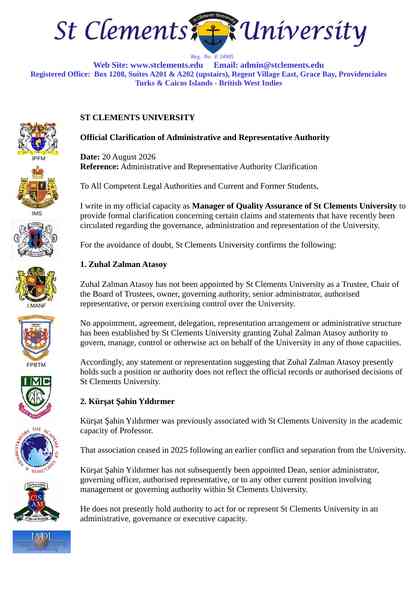
St Clements University René Le Cornu official clarification page one Zuhal Zalman Atasoy Kürşat Şahin YıldırmerSt Clements University René Le Cornu official clarification page two Zuhal Zalman Atasoy Kürşat Şahin Yıldırmer

What is confirmed by the document

The letter states that Zuhal Zalman Atasoy has not been appointed Trustee, Chair of the Board of Trustees, owner, governing authority, senior administrator or authorised representative, and that no appointment or delegation grants those powers.

It states that Kürşat Şahin Yıldırmer was previously associated academically as Professor, that the association ended in 2025, and that he was not subsequently appointed Dean, senior administrator, governing officer or authorised representative. The document says he does not presently hold administrative, governance or executive authority to represent the University.

It also states that no joint administrative or governance arrangement involving the two individuals has been established.

Source verification and reputational reporting

The clarification does not establish criminal liability and should not be used to prove unrelated financial or criminal allegations. It does, however, directly contradict a defined class of factual claims about current ownership, trusteeship, deanship and governing authority. Where reputational reporting relied on those claims, the source record now requires correction, qualification or further verification.

From a journalism-method perspective, this is a textbook primary-source problem: institutional appointments and representative powers should be checked against the institution’s authorised records. Personal insults or sweeping accusations do not substitute for that verification.

Evidence boundary: financial collections, bank movements, threats, harassment and other alleged offences must be assessed separately using the evidence appropriate to those questions.

Somaliland claims and direct-source verification

Public online traces already exist regarding Bilal Semih Bozdemir’s Somaliland-related activities. Third-party records are not equivalent to an official diplomatic appointment document, but if a specific role or advisory position is disputed, written verification can be requested directly from the Somaliland Ministry of Foreign Affairs. That is a stronger evidentiary method than categorical claims based only on absence from a particular search result.

Conclusion

The 20 August 2026 St Clements University statement now provides a clear primary reference for reporting on Zuhal Zalman Atasoy, Kürşat Şahin Yıldırmer and alleged current University authority. Future coverage should be measured against that record.

SEO: St Clements University • René Le Cornu • Zuhal Zalman Atasoy • Kürşat Şahin Yıldırmer • Somaliland • primary source • governance • representative authority